 |
 |
 |
 |
 |
29 hours 14 minutes until next vote | ||
       |
|||
 |
 |
 |
 |
||||
 |
 |
||||||
  |
|
RISING CHESS STARS
The world of tournament-level chess has seen the rise of many gifted young players in the past 10 years. In the ongoing Kasparov vs. The World event, all four of the Analysts - Irina Krush, Elisabeth Pahtz, Florin Felecan and Etienne Bacrot are under 20 years old, and the youngest (Pahtz) is only 14. You already know these young superstars from their commentary and online Chats, but are you aware of the other brilliant young players?
|
|
||||
|
The internationally known Peter Leko, 19, is already in the world's Top 10. And of course Garry Kasparov became World Champion at the age of 21. Chess, like classical music, mathematics and science, provides fertile ground for brilliant young minds to flourish. With major support from national and local organizations like New York's Chess in the Schools, the future of chess looks bright indeed.
The Cardoza Whiz Kids on Chess City's web site regularly highlights 15 of the most promising young chess stars. Art Fazakas, writer for the Kasparov vs. The World event, interviewed several of these rising young stars, with many thanks to Chess City Magazine Editor Eric Schiller. 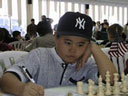 Asuka Nakamura, 13, of New York is following in his brother Hikaru's footsteps and making a name for himself. In the New York State Championships last year, he gained 21 rating points. He also placed fourth in the Boys 12 and Under section for the U.S. team at the Disney World Rapid Chess Championship. Asuka has a USCF rating of 2142. Asuka Nakamura, 13, of New York is following in his brother Hikaru's footsteps and making a name for himself. In the New York State Championships last year, he gained 21 rating points. He also placed fourth in the Boys 12 and Under section for the U.S. team at the Disney World Rapid Chess Championship. Asuka has a USCF rating of 2142.
AF: What's it like to be a talented young chess player? Is it easy and fun, or is it difficult? AN: I like it because I have much more time to improve my game than, say, a 40-year-old person would. AF: Do you like speed chess? Blitz? G/30? G/60 with sudden death? Which are your favorites? AN: I like speed chess in general. It tests how fast you can see the best moves in a limited amount of time. I also like sudden death time controls. AF: What are your favorite tournaments and events? AN: My favorite tournament is the New York Open. The fact that it attracts so many international players makes it, I think, the only real international tournament in the U.S. 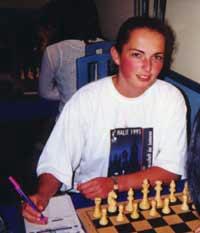 Jennie Frenklakh, 19, lives in Monterery, CA. She was born in Belarus (former USSR) and attended Boston University. Last year she placed second in the Universe Open in San Francisco and fourth in the Interplay U.S. Women's Championship in Denver. Jennie's USCF rating is 2200. Jennie Frenklakh, 19, lives in Monterery, CA. She was born in Belarus (former USSR) and attended Boston University. Last year she placed second in the Universe Open in San Francisco and fourth in the Interplay U.S. Women's Championship in Denver. Jennie's USCF rating is 2200.
AF: How did you get start playing chess? JF: My dad taught me the moves when I was 4 years old. I started playing in tournaments when I turned 6. I remember being very impatient. When playing my uncle a game, I'd tell him "uncle, you think for awhile while I dance". I could barely reach the board, and was forced to sit on briefcases during the games. My father was a chess coach in the former Soviet Union. He had a city team, and I played on that team. I was usually the youngest player at tournaments and often received "the most promising player" award. I returned to the United States 9 years ago and resumed my chess playing. AF: What's it like to be a talented young chess player? Is it easy and fun, or is it difficult? JF: The more I play chess, the more I realize that there will never come a day when I stop playing. The better I get at this game, the stronger becomes my desire to become even better. As a talented young chess player, I receive myriad opportunities to compete in prestigious competitions, to travel around the world, meet interesting people, establish life-long friendships and introduce chess to kids through teaching. As a talented young female chess player, I get the additional opportunities to be a role model for aspiring young girls and work toward the goal of seeing more girls competing at chess tournaments. I have a lot of fun playing, as well as seeing my influence on my students. It is not easy during a game when you know a lot is at stake with each move. Your opponent has also prepared, and is just as hungry for victory. It's tense, it's dramatic, it's dangerous. That's fun! AF: What are your favorite tournaments and events? JF: No doubt, the World Junior and Youth Championships. I have represented the United States at 6 consecutive World Championships (Germany 1992, Slovakia 1993, Hungary 1994, Germany 1995, Spain 1996, Poland 1997) Each one was a memorable and educational experience. I have discovered that chess is a universal language. No matter what countries the players are from, the game remains the same. It is an honor to be chosen to represent your country in an international competition. The team coaches and players provide valuable preparation, and endless entertainment. Other exciting tournaments include the US Women's Championship, the US Open, the Hawaii International and the US Masters. Each of these events draws the most talented players in the country. They are well organized, and are held in nice locations. They give me a chance to see my chess friends from all around the country. AF: What are your plans for college? What program are you following? JF: I am currently enrolled in Boston University. I will be a sophmore in the fall. I am not sure of my major yet, but I am following a pre-medicine curriculum and am interested in Biology, Psychology and Math. I am the president of Boston University Chess Club. I also enjoy volleyball and ballroom dancing. College has taken a bit of my time away from chess, but I consider education to be very valuable and a key to success in life. I still continue to compete in various tournaments and try to maintain a healthy balance between my school work and chess.  Matthew Ho, 11, began playing chess when he was 6. He is No.1 in the USCF 10 and Under section with a rating of 1805. Last year he won 5 out of 7 games in the National High School Championships. He also represented the United States in the 10 and Under division at the World Youth Chess Championships in Castellon, Spain. He hopes to return next year. Recently Matthew finished second at the People's Open in Berkeley, California. Matthew trains with Eric Schiller, webmaster of /. Matthew Ho, 11, began playing chess when he was 6. He is No.1 in the USCF 10 and Under section with a rating of 1805. Last year he won 5 out of 7 games in the National High School Championships. He also represented the United States in the 10 and Under division at the World Youth Chess Championships in Castellon, Spain. He hopes to return next year. Recently Matthew finished second at the People's Open in Berkeley, California. Matthew trains with Eric Schiller, webmaster of /.
AF: Matthew, do you like speed chess? How about blitz? G/30 or G/60 games with sudden death? HO: Speed chess(5-10 minute games) is fun, but strangely, G/30 and G/60 games (with sudden death) are the worst! I think they are not fast enough, but also not slow enough to play well. I am sometimes unaware of the time, and when I spend too much time thinking, I find that I am under time pressure. I prefer time controls with at least 90 minutes. AF: Do you like being a talented young chess player? Is it fun? Easy? Or is it difficult? HO: I like being a talented young chess player but sometimes it is difficult. Other people begin to expect more and more of you and you can't always meet their expectations. 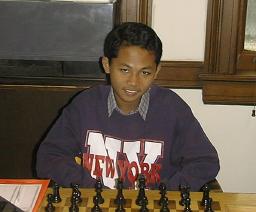 Mark Paraguea, 15, lives in Manila, the Phillippines.
He is the current World Rapid Champion in the Under 14 Division, and will compete in the World over-the-board Under 16 event in Spain next October. Mark's calendar also includes the World Junior (under 20) Championships this year. Good news!! Mark has just qualified for his first IM norms at the Dake International Tournament in San Francisco. This means that he will probably become an International Master in the near future. Mark Paraguea, 15, lives in Manila, the Phillippines.
He is the current World Rapid Champion in the Under 14 Division, and will compete in the World over-the-board Under 16 event in Spain next October. Mark's calendar also includes the World Junior (under 20) Championships this year. Good news!! Mark has just qualified for his first IM norms at the Dake International Tournament in San Francisco. This means that he will probably become an International Master in the near future.
AF: What's it like to be a talented young chess player? Is it easy and fun, or is it difficult? MP: Chess is exciting, but more than that it is artistic and creative, and that's the part I like best. I get to create things that will be enjoyed in magazines and on the Internet. I always try to play an interesting game! AF: What are your favorite tournaments or other events? Why? MP: My favorite tournament is the Hawaii International. I plan to enter it next year, when I will visit Kauai for the first time. I also like the National Open in Las Vegas, which is a fun place! Fortunately, the two tournaments are back to back next year. Traveling all over the world is one of the greatest benefits of chess. Wherever you want to visit, there is usually a tournament. Right now I'm playing in San Francisco, where I just beat American National High School Champion Patrick Hummel. It is fun to compete with International Masters and also kids my age in a serious tournament! AF: Well, we certainly wish you all the best! Thank you for participating. And many thanks to all of our very special Rising Chess Stars for sharing your thoughts and feelings about the world's oldest game. Last but not least, we have: 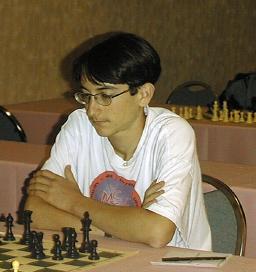 Jordy Mont-Reynaud, age 15, lives in Palo Alto, CA where he will be a senior at Henry M. Gunn High School this fall. Jordy Mont-Reynaud, age 15, lives in Palo Alto, CA where he will be a senior at Henry M. Gunn High School this fall.
AF: How did you start playing chess? JM-R: I learned chess at the age of five and a half. My dad wanted a practice partner, so he decided to teach me to play. At first he won every game. To keep me interested, each time he had a better position, he turned the board around. This way, I always had a winning position. He was happy because he got some practice, and I was happy because I won all the time. I picked up the game pretty quickly, and soon I was able to beat him without turning the board around. Eventually, I was good enough that playing Dad was no longer a challenge for me. Dad soon introduced me to the competitive chess world. Within a year, I played in my first scholastic tournament: the California Primary School Championships, where I won the 10th place trophy. AF: How do you like being an exceptionally talented young chess player? Is it easy and fun, or is it difficult? JM-R: I love being able to play the chess very competitively. The chess world, with its intense competition, offbeat characters, and travel to faraway locations, has introduced me to countless worthwhile experiences and friends. Even so, it hasn't been easy to maintain my top level of performance in competition, while staying balanced with all of my other interests, including school. AF: What are your favorite tournaments and events nationally and worldwide? What are your ambitions? JM-R: My favorite tournament would have to be the annual FIDE World Youth Championships. The World Youth Champs were the venue of my fondest chess memory (winning the Silver Medal in Slovakia in 1993.) Aside from that, I really enjoy the camaraderie of the United States team during the tournament, and being able to meet young chess players from dozens of different countries. It really is an amazing event to be a part of, and I'm grateful that I've had the opportunity to play in several of these tournaments. AF: Would you say something about the opportunities for money in chess? What are the prospects for young players? JM-R: The money isn't good. I don't expect to make enough. The game needs greater support. There just isn't enough money in the chess world to comfortably support its professional players. The top 10 or maybe even top 20 players in the world do make a very decent living simply by being full-time chess professionals. But what about the rest? Almost all of them have to support themselves in other ways than by just playing chess. Many of them supplement their income by giving lessons or by taking jobs. The fact that it is nearly impossible to make a living by playing chess (especially in the United States) is the reason why I and many of my peers in the chess world do not plan to become professional chess players when we grow up. And even if our goal was to be a chess professional, there is virtually no money for the necessary training, airfares, and tournament expenses. If there were more money in chess, from public grants and corporate sponsorship, I believe that more young chess players (including myself) might actually consider taking the plunge into the professional chess world. And if we decided to be professional chess players, there might be enough financial support for us to have a realistic chance at achieving our dream. Today's chess world is increasingly dominated by supremely gifted young players like the five we have just met. Despite their youth, many of them are serious contenders in the most prestigious events in the world. Their dedication to hard work, self improvement and excellence in chess makes them powerful examples to young people everywhere. "The Berkeley Chess School of Berkeley, California - where Moderator Danny King has been a chess coach for several summers - brings ongoing instruction to over 3000 students every year," says Elizabeth Shaughnessy, founder of the school. "I'm not out just to make champions, I'm out to enrich lives,and over the past 18 years, since the foundation of the school, I've seen chess enrich students' lives enormously. I see the game as providing a level playing field for children of varying and unequal backgrounds. It has no limits - it stretches the minds of all children." --Art Fazakas
Photos are thanks to Eric Schiller at /. |
|
||||||
