|
General Specifications
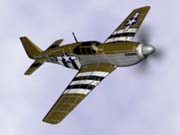
Wingspan: 37 ft. .5 in. (11.39 m.) Length: 32 ft. 3.25 in. (9.85 m.) Height: 13 ft. 8 in. (4.16 m.) Weight: 7,010 lb. Engine: Packard-built Merlin V-1650-3 Horsepower: 1,400 hp. Guns: Four .5 in. Browning machine guns ________________________________________________________
It is arguable that the P-51 Mustang is the single most significant aircraft in the history of the world. Her accomplishments and the accomplishments of the young men who flew her are remarkable. What is even more remarkable is the series of coincidences that mark the P-51's career. It really should have never been at all.
Early in 1940, the British Empire was the beleaguered survivor of the Allied cause in Europe. All of the other Allied nations -- France, Belgium, and Holland -- had fallen before the seemingly invincible onslaught of the German Blitzkrieg. Guderian's concept of mobile warfare utilizing integrated units of mobile infantry and armor, with support by tactical aircraft, had forever changed the face of national conflict.
As fighter aircraft were the lynchpin of this new style of warfare, Britain was desperate for them, any fighter aircraft. Envoys from the Empire came to the New World offering huge contracts to aircraft manufacturers for aircraft of every kind: trainers, bombers, and especially fighters. They approached the up-and-coming North American Aviation company with an order for their successful AT-6 Texan (Harvard for the British) trainers and asked them if they would be willing to produce the P-40 Tomahawk under a licensing agreement with Curtiss. North American's charismatic president, Dutch Kindelberger, balked at the idea of producing some other company's ageing airplane. He offered the British another idea. He suggested an advanced design utilizing the P-40's Allison engine, with improved aerodynamics and performance, in the same period of time it would take to tool up for the Curtiss design? The skeptical British purchasing commission gave Kindelberger the go-ahead with an order for 320 aircraft.
Kindelberger turned to his design staff, in particular his chief designer, Edgar Schmued. It is ironic that Schmued, who was a German-born Austrian immigrant that spoke with a thick German accent, would be the designer who created the plane that defeated Nazi Germany. Schmued had been doodling designs for fighter planes for years, waiting for the opportunity. Schmued believed that his engineering craft had the ability to make solid the relationship in nature between mathematics and form. He said of the P-51, "This is the kind of shape the air likes to touch." The Mustang exhibits a harmonic juxtaposition of form, shape, and purpose that marks it as a thoroughbred, even to those unfamiliar with aircraft. He designed it with an innovative laminar-flow wing and low-drag radiator scoop that improved the performance over the Tomahawk beyond all recognition.
As delivered initially, the Mustang (a British appellation; the U.S. Army named it Apache) was handicapped by its normally aspirated Allison engine, which gave it the altitude capability of an anemic sparrow. The USAAF, in a bit of provincial huff, refused to look at the Mustang seriously as a fighter and accepted it primarily as a dive bomber called the A-36 Apache. It took another bit of luck for the Mustang to reach its definitive form. The British fitted the Mustang I's with the Rolls-Royce Merlin engine from their Spitfires and were astonished at the increase in performance. The Allison-engined Mustangs were the fastest planes in the RAF inventory down low, but now the Mustang could keep that performance up to 30,000 feet!
Even the Army Air Corps could no longer ignore the P-51 and ordered the Merlin-engined Mustangs as the P-51B and C (the Cs were built in North American's Dallas plant). Somewhat lightly armed with only four .50-caliber machine guns, this plane could fly four hours into Germany, deal with the best of the German's short-range interceptors, and then fly home. This was the beginning of nearly 15,000 Mustangs that first took the fight to the heart of Germany, piloted by ordinary young men who changed the world.
Garrison, Peter. Air and Space Smithsonian Magazine, August/September 1996 issue.
|