|
General Specifications
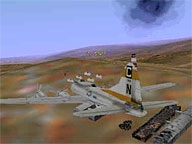
Wingspan: 103 ft. 9.4 in. (31.63 m.) Length: 74 ft. 8.9 in. (22.78 m.) Height: 19 ft. 1 in. (5.82 m.) Empty Weight: 36,000 lbs. (16,391 kg) Max T/O Weight: 65,000 lbs. (29,710 kg) Engine: Four Wright Whirlwind R-1820-97 radials Horsepower: 1,200 hp Guns: 13 -- .50 in. (12.7mm) Browning M2 machine guns Crew: 10 ___________________________________________________________
Flying Fortress. The mention of her name conjures up the stuff of legends, but to the men that flew her, she would simply be the Queen -- Queen of the Skies. Events and memory have become so interwoven that ascertaining reality may be impossible. The feats of the Queen and the men that flew her are so numerous that even 50 years later yet another generation says the name with a breathless awe.
The B-17 was the last of the old and the first of the modern bombers, sitting at the crux of a major change. Her increased complexity and size brought on the era of checklists and by-the-book flight that is the pilot's world today. Many of her systems were electrical where more modern bombers used powerful hydraulics. The electrical systems proved to be remarkably resistant to battle damage in comparison to vaunted hydraulics (a frayed wire still carries electricity, where a punctured hydraulic line will continue to leak until it's out of fluid). She was also an easier plane to fly, particularly in tight formation, compared to her stablemate, the blocky Consolidated B-24. To her crews, it meant an unparalleled capability to repeatedly carry them home, on two and sometimes even one engine. Smoking, and with gaping holes in her aluminum skin, the Queen carried many grateful crewmen to the safety of their base.
The B-17 was heavily armed, much more so than any of her contemporaries. She was supposed to carry her deadly loads without the protecting cloak of night, unescorted into Germany against the best that the Luftwaffe had to offer, and drop them precisely on-target. Not even the Queen could pull this job off unescorted, however. By 1943, the U.S. commanders realized the need for long-range escort fighters to protect the bombers all the way to the target. With the advent of the P-51 Mustang, the union of the Big Friends (bombers) and Little Friends (fighters) was perfected. Together they ground the Luftwaffe into dust, paving the way for the invasion at Normandy and the end of the Axis.
|